BGE Engineering Science · Level 3–4 project
Why do bridges stay up? Discover how engineers design structures that cope with forces, from the first human buildings to bridges and skyscrapers. Learn about tension and compression, frames, and how to calculate moments.

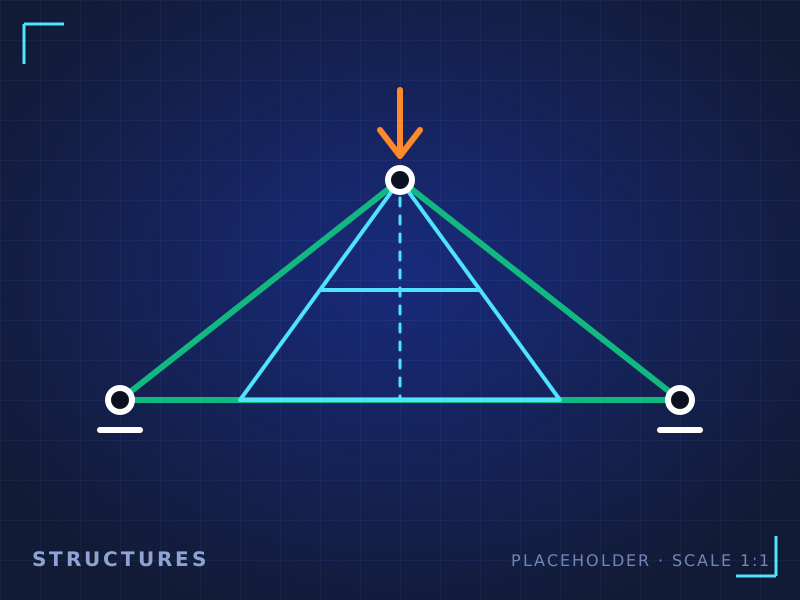
SCALE 1:1
BGEStructures

SubjectEngineering Science
LevelBGE · Level 3–4
LicenceFree to copy, adapt, share
Sheet04.4 · BGE · Structures
01Course notes
Start with the Structural Engineering course notes. Use the knowledge organiser to revise the key words and ideas. Print to write on, or use the Type-in version on screen.
02Worksheets
Three worksheets that follow the course notes, a moments practice pack, and the Bridge Truss Challenge, where you design, make and test your own bridge truss.
03Homework
One homework pack that covers the whole topic. Print it to write on, or use the Type-in version to answer on screen.
04The online course
You do not need to install anything. DesignClass StructuresPro runs on your school computer, in the browser, with no log-in. Play the missions alongside the course notes and worksheets, and save your progress file at the end of every lesson so you can carry on next time.

05What you’ll learn
Every bridge, crane and skyscraper is a structure that has to carry loads safely. Learn how engineers think about forces, then use what you learn to design and make your own small bridge truss.
01
Meet structural engineers and their careers, see how animals build, and sort human structures into mass, frame and shell.
02
Explore the six types of bridge, the difference between mass and force, and what tension and compression do to a material.
03
Name beam sections, stiffen frames with cross-bracing, then calculate moments around a pivot using force × distance.
06For teachers
A teacher guide with a nine-week lesson sequence, links to the Know-Do-Understand framework and N5 Engineering Science, and answers to every worksheet, homework and practice question; a 40-mark topic test with marking instructions; and three editable lesson PowerPoints. Teacher resources are part of DesignClass teacher membership, which keeps the site free for pupils.
Teacher membership
Members get the lesson slides, answers, assessments and marking schemes for every DesignClass project, plus early access to new projects. Membership is £5 a month or £50 a year, and it keeps DesignClass free for every pupil in Scotland.
07Keep building
Structures done? Try electronics, or see where engineering goes next.

01
Energy, circuits and resistance, then solder your own torch.
Open Electronics →
02
Mechanisms and structures are a key part of National 5. See what comes next.
Open N5 Engineering Science →
←
Structures, electronics, pneumatics and computer control for S1–S3.
Back to BGE Engineering Science →
“Engineering is the art of directing the great sources of power in nature for the use and convenience of man.”
Thomas Tredgold