National 5 Engineering Science · Electronics and Control
Everything you need for the electronics half of N5 Engineering Science: 11 units, 36 lessons and 8 practicals in six topics. Every lesson has notes and a worksheet that climbs from Core to Stretch to Exam Ready, and every PDF comes as a print version and a type-in version you can fill in on screen.
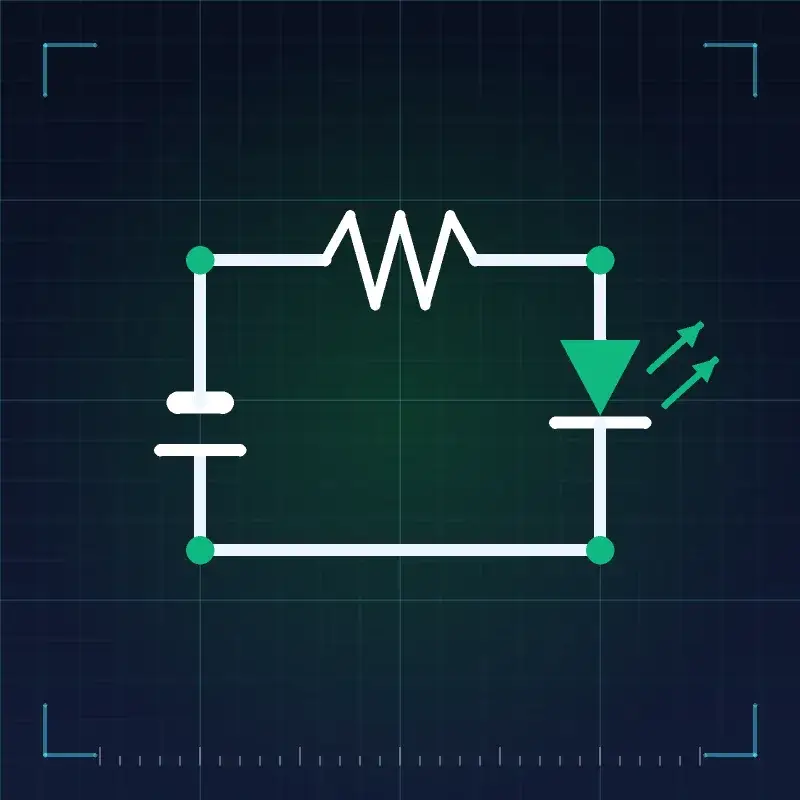
SCALE 1:1
N5Electronics

SubjectEngineering Science
LevelNational 5
LicenceFree to copy, adapt, share
Sheet04.4 · N5 · Electronics
01Choose a topic
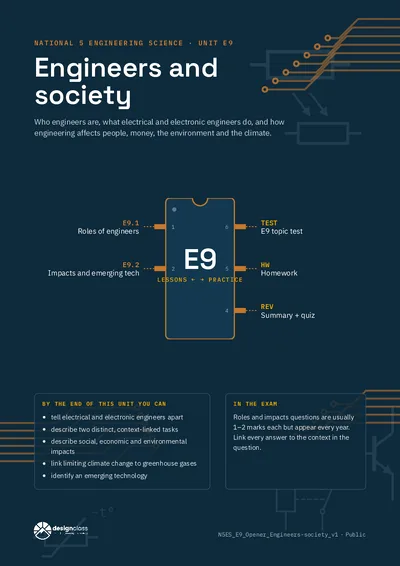
Six topics, in teaching order. Each topic page has the unit opener, notes and worksheets for every lesson, the one-page summary, homework and practicals.
02Course tools
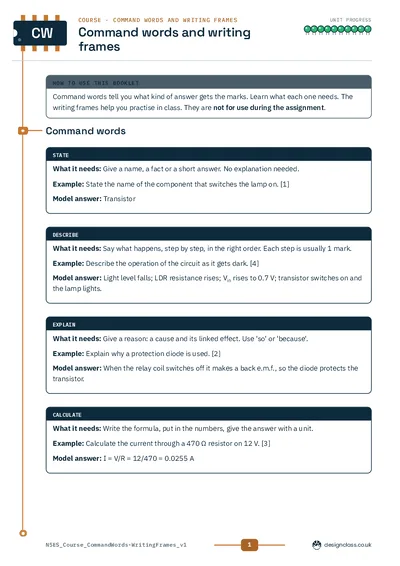
Use the command words sheet to see exactly what “describe”, “explain” and “calculate” ask you to do, and use the course tracker to rate yourself on every point in the course specification. Writing frames are for class practice only. They are not allowed during the assignment.
03What you’ll learn
These topics cover the electronics and control content in the National 5 Engineering Science course specification, and the skills you need for the question paper and the assignment.
01
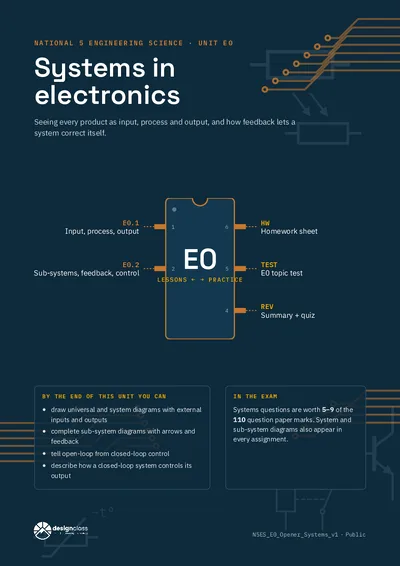
Describe engineering systems using input, process and output, sub-systems, open and closed loop control and feedback.
02
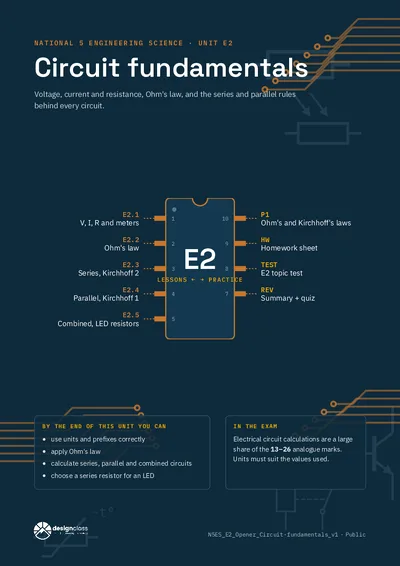
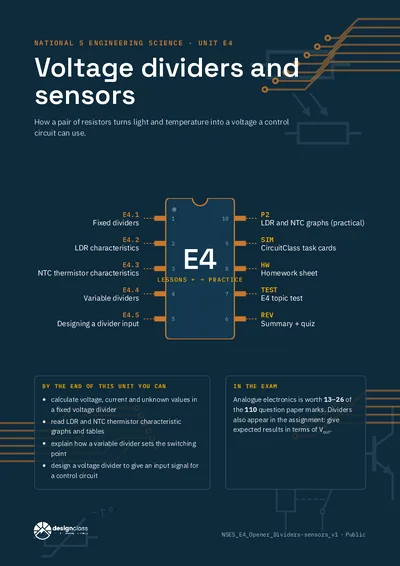
Use Ohm’s law, Kirchhoff’s laws, voltage dividers, power and efficiency to calculate values in series, parallel and combined circuits.
03
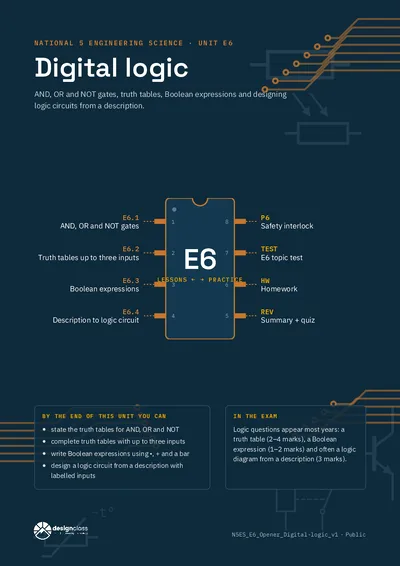
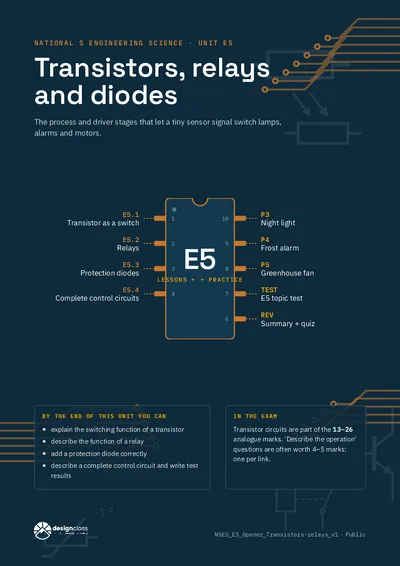
Use LDRs, thermistors, transistors, relays and diodes, and design logic using gates, truth tables and Boolean expressions.
04
Write flowcharts for microcontroller control, test them in a simulator, and explain the impact of engineering on society and the environment.
04For teachers
A teacher guide and an editable PowerPoint for every lesson, topic tests with marking instructions, homework answers, quiz banks, technician sheets for all eight practicals, a past paper index (2014–2026) mapped to every lesson, two original practice papers and three original practice assignments. Teacher resources are in the Teacher Portal (National 5 Engineering Science) for DesignClass members.
Teacher membership
Members get the lesson slides, answers, assessments and marking schemes for every DesignClass project, plus early access to new projects. Membership is £5 a month or £50 a year, and it keeps DesignClass free for every pupil in Scotland.
05Keep building
Test your circuits before you build them, or head back to the rest of the course.

App
Build the circuits from these lessons on screen, take live readings and try the task cards.
Open CircuitClass →

Course
All four areas of the course, plus past papers from 2014 to 2026.
← Back to N5 Engineering Science

BGE
Need a refresher? The BGE electronics project covers the basics: energy, current, voltage and resistance.
Open BGE Electronics →
“Sense it. Switch it. Control it.”
N5 Electronics, DesignClass